
The Floating World Emerges: Japanese Prints from the Clarence Buckingham Collection at the Art Institute of Chicago


The Main Gate, New Yoshiwara
c. 1745
Torii Kiyotada (Japanese, active c. 1716–51)
Hand-colored woodblock print; toku-oban yoko-e, beni-e
Clarence Buckingham Collection
1939.2152
© The Art Institute of Chicago


The Floating World Emerges

Japanese Prints from the Clarence Buckingham Collection


June 24, 2026 — September 6, 2026

The ideology that would become known as the floating world (ukiyo) developed following the great fire of 1657 in which vast portions of the city of Edo (now Tokyo) were destroyed.

Just a few years after that fire, in 1665, author Asai Ryōi described what this attitude was: “living only for the moment, turning our full attention to the pleasures of the moon, the snow, the cherry blossoms and the maples, singing songs, drinking wine, and diverting ourselves just in floating, floating, caring not a whit for the poverty staring us in the face, refusing to be disheartened, like a gourd floating along with the river current: This is what we call ukiyo.” 

Pictures of the floating world (ukiyo-e) subsequently became essential portrayals of city life in the 17th century. Prints and paintings of women wearing elaborate kimonos appealed to urbanites’ sense of fashion and style, while depictions of Kabuki actors and their hedonistic existence provided excitement. Courtesans, who played a significant role in a society that glorified their appearance and glossed over their reality, were also a frequent ukiyo-e subject. 

Prints were a profitable way to give the public the images they craved as mementos of their experiences or their fantasies. The appeal of ukiyo-e continued for almost 200 years, and the printing technology that developed as a result, especially color printing, reached heights unknown in the rest of the world.

This presentation brings together about 40 ukiyo-e prints, many given to the museum by a major collector and an early supporter of the Art Institute, Clarence Buckingham.

The Floating World Emerges: Japanese Prints from the Clarence Buckingham Collection is curated by Janice Katz, Roger L. Weston Curator of Japanese Art, Arts of Asia.


Exhibition Preview
 

The Treasure Ship
c. 1712
Attributed to Furuyama Moromasa (Japanese, c. 1712-1772)
Hand-colored woodblock print; horizontal o-oban, sumizuri-e
Clarence Buckingham Collection
1925.1742
© The Art Institute of Chicago

A Hawk Capturing a Crane in Flight
c. 1715
Torii Kiyomasu I (Japanese, active c. 1704–18)
Hand-colored woodblock print; vertical o-oban, tan-e
Clarence Buckingham Collection
1925.1734
© The Art Institute of Chicago

Standing Geisha
c. 1748
Ishikawa Toyonobu (Japanese, 1711–1785)
Hand-colored woodblock print; urushi-e, vertical oban diptych
Clarence Buckingham Collection
1925.2254
© The Art Institute of Chicago

The Actor Sanogawa Ichimatsu I in an Unidentified Role
c.1743
Okumura Masanobu (Japanese, 1686–1764)
Hand-colored woodblock print; urushi-e, habahiro hashira-e
Clarence Buckingham Collection
1925.1745
© The Art Institute of Chicago

An Elegant Lady
c. 1715
Okumura Masanobu (Japanese, 1686-1764)
Hand-colored woodblock print; vertical o-oban, tan-e
Clarence Buckingham Collection
1925.1743
© The Art Institute of Chicago

The Actor Yamashita Kinsaku holding a puppet of the Empress in the play “Diary Kept on a Journey by Sea to Izu (Funadama Izu Nikki),” performed at the Nakamura Theater in the first month, 1725
Torii Kiyonobu II (Japanese, active c. 1725–61)
Hand-colored woodblock print; hosoban, urushi-e
Clarence Buckingham Collection
1925.1763
© The Art Institute of Chicago

The Actor Segawa Kikunojo II as Shirabyoshi Renri in the play “Imayo Dojoji” performed at the Ichimura Theater in the eleventh month, 1756
Torii Kiyomitsu I (Japanese, 1735–1785)
Color woodblock print; o-hosoban, benizuri-e
Clarence Buckingham Collection
1929.72
© The Art Institute of Chicago

The Actor Sanogawa Ichimatsu I as Hisamatsu
c. 1748
Ishikawa Toyonobu (Japanese, 1711–1785)
Hand-colored woodblock print; habahiro hashira-e, urushi-e
Clarence Buckingham Collection
1931.243
© The Art Institute of Chicago

The Actor Fujimura Handayu II as Oiso no Tora
c. 1715
Torii Kiyomasu I (Japanese, active c. 1704–18)
Hand-colored woodblock print; o-oban, tan-e
Clarence Buckingham Collection
1925.1732
© The Art Institute of Chicago

Courtesan Walking
c. 1714
Kaigetsudo Anchi (Japanese, active c. 1704–16)
Hand-colored woodblock print; tan-e, vertical o-oban
Clarence Buckingham Collection
1925.1741
© The Art Institute of Chicago

The Actor Sanogawa Ichimatsu I performing the spear dance
c. 1756
Torii Kiyohiro (Japanese, active c. 1737-76)
Color woodblock print; o-hosoban, benizuri-e
Clarence Buckingham Collection
1925.1912
© The Art Institute of Chicago

Standing Figure of a Woman
c. 1715
Torii Kiyomasu I (Japanese, active c. 1704–18)
Woodblock print; o-oban, sumizuri-e
Clarence Buckingham Collection
1925.1729
© The Art Institute of Chicago

Courtesan Holding a Long Pipe
c. 1743
Ishikawa Toyonobu (Japanese, 1711–1785)
Hand-colored woodblock print; habahiro hashira-e
Clarence Buckingham Collection
1925.2250
© The Art Institute of Chicago

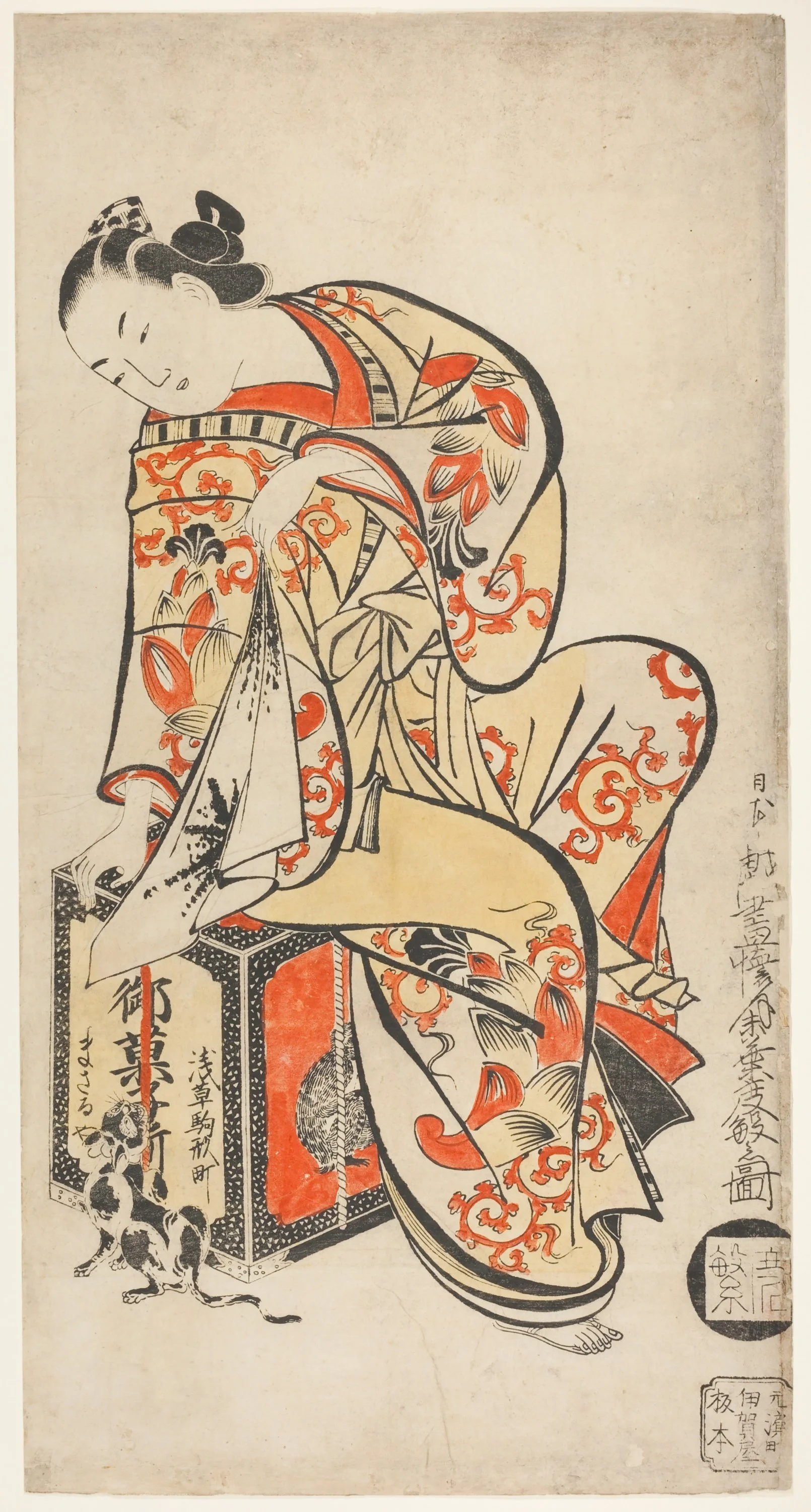
Courtesan Playing with a Cat
c. 1715
Kaigetsudo Dohan
(Japanese, active c. 1704-16)
Hand-colored woodblock print; tan-e, vertical o-oban
Clarence Buckingham Collection
1925.1740
© The Art Institute of Chicago

A Hawk on a Cliff near a Kiri Tree
c. 1716
Torii Kiyomasu I (Japanese, active c. 1704–18)
Hand-colored woodblock print; o-oban, tan-e
Clarence Buckingham Collection
1925.1735
© The Art Institute of Chicago

The Actors Yamashita Kinsaku I and Hayakawa Hatsuse as puppeteers in the play “Diary Kept on a Journey by Sea to Izu” (“Funadama Izu Nikki”), performed at the Nakamura Theater in the first month, 1725
Torii Kiyomasu II (Japanese, 1706–1763)
Hand-colored woodblock print; hosoban, urushi-e
Clarence Buckingham Collection
1942.72
© The Art Institute of Chicago

A Courtesan with Her Child Attendant
c. 1715
Torii Kiyonobu I (Japanese, 1664–1729)
Woodblock print; o-oban, sumizuri-e
Clarence Buckingham Collection
1925.1705
© The Art Institute of Chicago

A Young Woman Walking near a Plum Tree
c. 1688
Hand-colored woodblock print; o-oban, tan-e
Clarence Buckingham Collection
1925.1703
© The Art Institute of Chicago

The Main Gate, New Yoshiwara
c. 1745
Torii Kiyotada (Japanese, active c. 1716–51)
Hand-colored woodblock print; toku-oban yoko-e, beni-e
Clarence Buckingham Collection
1939.2152
© The Art Institute of Chicago

A Young Woman Watching Frogs (parody of Ono no Tôfû)
c. 1760
Torii Kiyomitsu (Japanese, 1735–1785)
Color woodblock print; oban, benizuri-e
Clarence Buckingham Collection
1957.560
© The Art Institute of Chicago

Parade of the Puppets
c. 1700
Okumura Masanobu (Japanese, 1686-1764)
Hand-colored woodblock prints; oban yoko-e, tan-e
Clarence Buckingham Collection
1925.2255
© The Art Institute of Chicago

The Actor Segawa Kikunojo I as a courtesan
c. 1747
Ishikawa Toyonobu (Japanese, 1711–1785)
Hand-colored woodblock print; vertical oban diptych, beni-e
Clarence Buckingham Collection
1925.2252
© The Art Institute of Chicago

A Collection of Flowers and Birds (Kacho zukushi)
Edo period (1615-1868), 1683
attrib, Hishikawa Moronobu 菱川師宣 (Japanese, 1618-1694)
Woodblock-printed book, sumizuri-e
Martin A. Ryerson Collection
2022.1407
© The Art Institute of Chicago

A Parade of Courtesans
c. 1690
Hishikawa Moronobu (Japanese, ?-1694)
Woodblock print; sumizuri-e, kakemono yoko-e
Clarence Buckingham Collection
1925.1702
© The Art Institute of Chicago

An Interrupted Embrace
c. 1685
Attributed to Sugimura Jihei (Japanese, active c. 1681-98)
Hand-colored woodblock print; oban, sumizuri-e
Clarence Buckingham Collection
1925.1687
© The Art Institute of Chicago

A Courtesan with Her Client, the first sheet of an untitled erotic picture album
c. 1673/81
Hishikawa Moronobu
Woodblock print; sumizuri-e, oban yoko-e
Kate S. Buckingham Endowment
1973.645.9
© The Art Institute of Chicago