
Oceanic Art in the Los Angeles County Museum of Art
Oceanic Art in the Los Angeles County Museum of Art
Curated by Steven G. Alpert
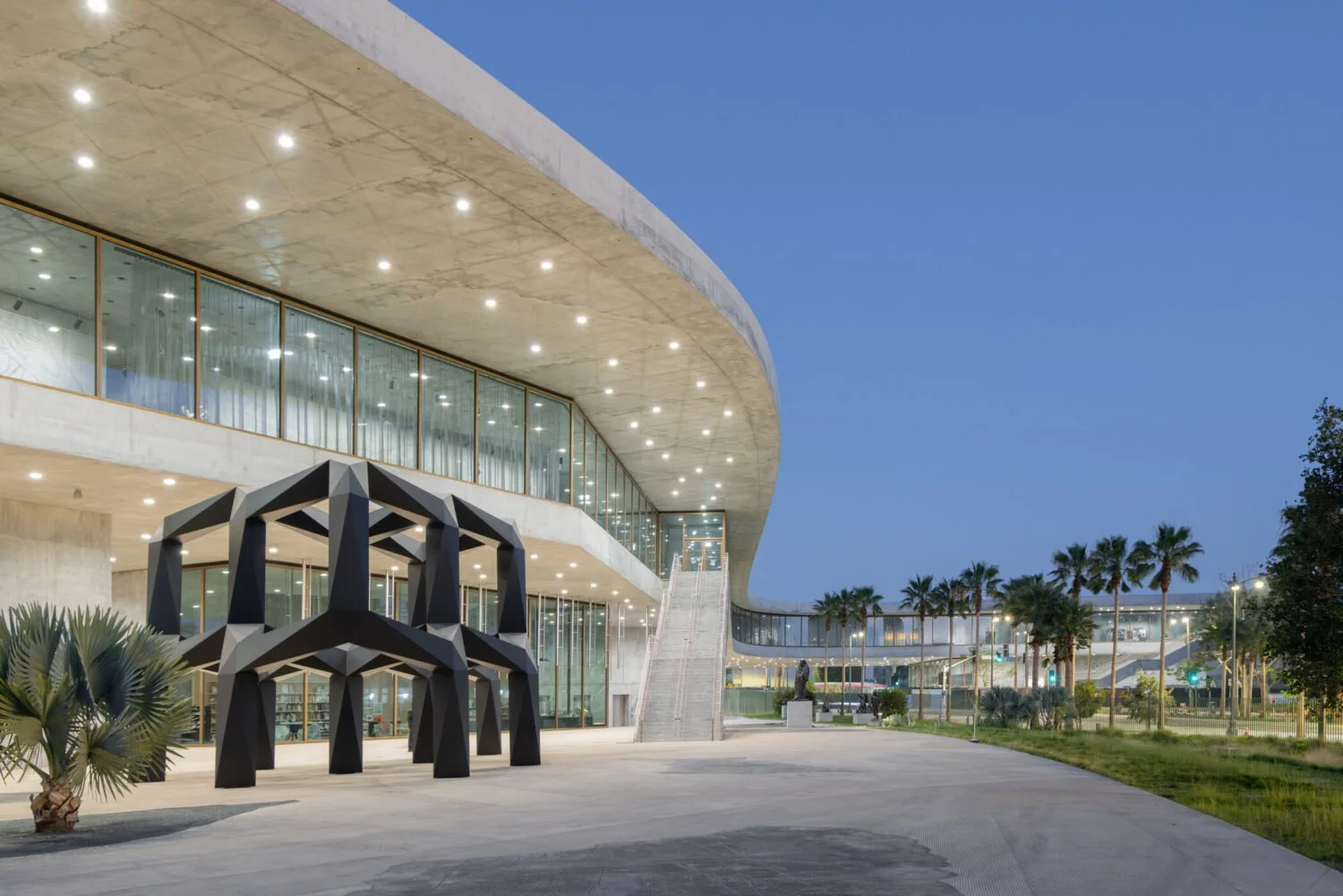
This month, the lead feature of Art of the Ancestors highlights the newly opened David Geffen Galleries at the Los Angeles County Museum of Art.
Replacing four earlier structures, LACMA's newest building was designed by award-winning Swiss architect Peter Zumthor. Although I have yet to see the new structure in person, I find images of its architecture and uninterrupted wrap-around inner gallery spaces to be enticing and sinuously impressive. Following in the footsteps of masters like Louis Kahn and Tadao Ando, Zumthor's design boldly integrates glass, steel, and exposed concrete. The carefully calibrated natural, but diffused lighting clearly enhances exhibition spaces with a sense of warmth, additional depth, and good viewing angles.
Overall, LACMA stewards some 150,000 items, making it the largest collection in the public domain in the Western United States. The new Geffen Galleries provide 110,000 square feet of exhibition space. One LACMA VP recently described in a press conference that their novel exhibitions were taking a new cultural approach that was described as a 'sense of water geographies rather than nation-states.' At that same press conference, the term "Oceans Not Borders" was publicly coined. This is not simply a buzzword, but a concept that frames the building and its new exhibitions. Here, works of art and cultural artifacts, spanning some 6,000 years of human history, have been curated and arrayed in cross-cultural settings. Such a mélange of items reflects, and was partly chosen to celebrate, our universal need to create and communicate through art. The setting aims to provide museum-goers enough grist for thought-provoking conversations and deeper insights into humanity's collective creative experience.
The theme of 'Oceans Not Borders' also further reflects Los Angeles' position as an outward and forward-looking Pacific Rim locale. Mirroring this orientation and the longtime vision of the museum's director, Michael Govan, LACMA's featured holdings include masterworks of Oceanic Art, including material from Polynesia, Micronesia, Melanesia, Papua New Guinea, and Indonesia (West Papua). The items illustrated in this piece were all formerly in the MASCO Corporate Collection. The collection's development was advised by Michael Kan, who, in his day, was a highly regarded curator at the Detroit Institute of Arts. Much of its content was gathered by the late Wayne Heathcote, who bought many of these items at auction, as well as from other vendors and private collections, during his prime as an art dealer. The most illustrative material is drawn from historically documented collections and rises (as seen in the enclosed illustrations) to a high caliber of aesthetic quality and desirability.
In 2008, LACMA acquired forty-six items from the MASCO Collection in addition to some gifted material. Here are eighteen selections from that group. Each item is from an island bounded (at least in part) by the Pacific Ocean. From New Zealand, the standout sculpture at LACMA is a teko-teko, or peaked gable ornament from either a storage house (pataka), meeting house (wharenui), or chiefly dwelling (wharepuni). Even decontextualized, the ornament's central figure's stance remains hyper-alert and vigilant. Polished circular and serrated paua shell eyes (halitosis) and the head's slightly tilted mien can still immediately engage us. Its gaping mouth is filled with human teeth and the figure's firm stance is vigorous, protective, and aggressive; all perhaps reflecting attributes of its original owner: the status of a chiefly family or of an important ancestor. The carving's general style, execution, and the wood's surface suggest non-metal tooling. This most likely dates LACMA's teko-teko to what has been described as a "flowering" period of Maori art from the 18th century. Originally purchased in 1932 by the legendary collector, James Hooper, this gable ornament is an outstanding example of its genre.
Also from New Zealand is the frontal view of a war canoe prow said to have been collected before 1860. Maori war canoes (tauihu), which could range from 30-130 feet long and be manned by up to 80 paddlers and warriors, were, and still are, a magnificent sight to behold. Such canoes were richly ornamented with a prow figurehead and a towering carved stern post. It is said that prow figures with swept-back arms and a stout chest cresting just above the waves are typically associated with mythical deities such as Tumatauenga (the god of war). Prow ornaments also both informed and requested the blessings of the god of the sea, Tangaroa, when a war party was traversing over his domain. At 54 inches long and of thick, sturdy volumes, this war canoe prow does not have the proportions of a smaller for-sale version, but the size and grandeur of an actual tauihu.
The last Māori item illustrated relates to traditional tattooing (ta moko), especially the creation of a mataora, or full facial tattoo. A person's head, their face, and their mouth were considered tapu (the source of our word taboo) and were never directly touched during this process. This fine Northland feeding funnel dates to the late 18th or very early 19th century. It was used to provide a specially prepared semi-liquid sustenance to feed a chief while his face (and new soul) were healing from such a physical and spiritual ordeal. The funnel's design is composed of a series of faces plus the beaks, talons, leg bones, and body parts of the manaia, a sacred bird-like creature. In this composition, their fragmentary or floating parts are overlaid and conjoined by meandering curvilinear forms. The manaia is a ubiquitous but sacred device in Māori art. These bird-like creatures have many functions, but ostensibly serve as protectors—supernatural guides—or invisible connectors that flow or move between the world of the living and the realm of the ancestors.
Two other reproduced items hail from the East-West boundaries traditionally ascribed to Polynesia. The first is a superb example of an Easter Island dance paddle (rapa) that depicts what is generally considered to be an abstracted face with long ears. The paddle's upper half projects a face on each side while the paddle's grip can be likened to an elongated human neck. The lower portion of the paddle's blade is commonly said to represent a torso sporting a rounded abdomen ending in a phallic-like extension. The only other paddles with sophisticated, subtle double-sided faces (that also could be said to end in a penile point or grip) that immediately come to mind are those from Santa Cruz (in the Solomon Islands) that, at their best, like an Easter Island paddle, can project timeless abstract renderings that reflect or perhaps suggest something deeply drawn from the core of the human spirit. The second item is from Far Western Polynesia. It's a small, early ancestor figure (matakau) from Fiji, dating to the 18th century or the very early 19th century, of a type kept in a miniature spirit house when it was not being utilized or venerated. Its planes, surfaces, and style reflect the influence Tonga exerted on nearby Fiji in pre- and early-contact times. Particularly important in these exchanges were the Tongan master boat-builders who settled on the island of Vitu Levu. They are credited with creating many of the region's most notable artworks in shell, ivory, sennet fiber and wood, including this rare statue. (Ex-collections: Kenneth A. Webster and James Hooper.)
Eight items: Four from the island of Papua New Guinea and four from the nearby eastern islands of New Ireland and New Britain (now provinces of the independent nation of Papua New Guinea) are also included in our introduction to LACMA's holdings. From Indonesia's portion of Papua, there is a fine Lake Sentani lime spatula. Slaked lime is highly alkaline, has a cooling effect in a spicy quid, and is used as a catalyst to release the mild psychoactive alkaloids of the areca palm nut. Chewing a quid of betel produces a light sense of calm, spatial equilibrium, alertness, and reduced stress, all while suppressing one's hunger or appetite. The guardian of this important stick or tool is a crouched figure. He's finely carved and conveys in miniature what one might find in the best renderings of much larger-sized Lake Sentani ancestor figures. Indeed, throughout the art of Eastern Indonesia, great figurative carving often "conveys an air of equanimity and general repose" (Kooijman: 1959, Wardwell: 1995). This spatula was collected during Jacques Viot's 1929 epic visit there. Pierre Loeb, the famous French art dealer who championed 20th-century modernism and Surrealism, sponsored his trip (quite a tale unto itself). Loeb's affection for Surrealism, combined with Viot's flair for collecting in situ, allowed him to immediately appreciate and introduce the art of Lake Sentani, especially their intricate maro bark paintings, to a wildly admiring coterie of collectors and artists in Paris in the 1930s (See: Greub: Art of Northwest New Guinea, 1992, p.p. 127-190)
Two other iconic pieces that reflect typical items from New Guinea of a certain era include a hunched ex-John Hewitt Biwat figure and a coastal-style Lower Sepik mask collected by F. Hefele in 1909. The Biwat figure possesses muscular limbs and a bold face that is accentuated by powerful shell eyes. The statue's crown is adorned with a wig (possibly added later) of fluffy cassowary feathers. Although known as 'flute stoppers', these statues actually sat atop sections of bamboo that were largely ceremonial and not played, and that "should therefore be regarded more as sacred idols than musical instruments." (M. Mead: 1934, p.p. 237-38). Masks are very important in Melanesian culture as they can greatly range in size and purpose, from small charms to large house gables. LACMA's mask represents an important mythical or deceased ancestor whose wisdom and protection can be called upon during initiations, naming, or rite-of-passage ceremonies; at secret society events; or worn to celebrate agricultural cycles that imbue the surroundings with increased fertility. (Wardwell 1971: p.12). Beyond being finely conceived and rendered, the merger or overlay of a carved totemic lizard-like, crocodilian, or saurian being suggests seamless communication between the spirit world and one's ancestors. Another New Guinea offering is a pigment dish from the Iatmul people from the East Sepik River region. Most of these dishes, especially when they are early, can be particularly well done. Generally, they feature avian, saurian, or crocodilian components or elements. Here, the depiction of a human figure is uncommon. She's a squatting female figure surrounded by flowing asymmetrical designs, worked with an assuredness that can perhaps be artistically equaled in similarly related items, but not excelled. Here, the wood is thin, as the dish feels like a piece of family plate or fine china; a fitting holder for ritual pigments that are intended to powerfully color, sanctify totemic and ancestral associations, and vividly celebrate life.
To the East of New Guinea lie the two archipelagos, New Ireland and New Britain. There, the finest works of art are known for their seemingly boundless creativity. Even without fully understanding their deepest meanings, their finest creations still delight and inspire international audiences. A New Ireland mask and an accompanying uli figure from the Mandak people of the Lelet plateau are of early provenance and excellent quality. Similar items have often been previously explored in multiple Art of the Ancestors’ posts and articles. Carved by specially trained experts who held the rights to specific patterns and forms, Malangan material is at the core of identity-bearing fertility rituals and mortuary practices. (See: New Ireland cultural material appears in numerous collections featured on Art of the Ancestors, which you can explore through our search functionality. For a more in-depth look, visit “New Ireland: Art of the South Pacific” by Michael Gunn and “Uli: Powerful Ancestors from the Pacific” by Jean-Philippe Beaulieu).
From nearby New Britain, there are several gems that do not normally appear in American collections. These include a bearded wooden Tolai figure with upraised arms painted in white, red, and Reckitt's blue pigment. The Tolai were known primarily for figures and open-worked short staffs that are associated with initiations into secret 'medicine' societies (Iniet). They used these items in processions, dances, and mock assaults on new initiates. Given this particular figure's size, it likely came from a large dancing staff or a post that witnessed ritual events and also appeared at name-giving ceremonies. Like a number of Oceanic pieces now in LACMA, they were deaccessioned from what were then either West or East German museums. This fine figure once resided in the Linden Museum, Stuttgart, where an important assemblage of Tolai material still remains. The second item, also of a fantastical bent, is a large and impressive (it's 61 inches tall) dance headdress composed of finely colored basketry with attached wooden breasts, feet and hands. The Sulka people are renowned for their multi-colored mortuary headdresses. Some take the form of single or Janus figures, such as this example, or part of conical or umbrella-like constructions featuring birds, mythical animals, and even praying mantises. This item is again a pre-World War One era piece from Germany, ex-Rheinische Mission Society (Rheinische Missionsgesellschaft), which has been headquartered in Wupperthal-Barman since 1828.
It is not easy to pick favorites here, so I'll end this presentation with four gems. First up is a hardwood food platter (rova) from one of the northern island groups of Espiritu Santo, the largest Island in Vanuatu. These platters were used at communal dinners and for the ceremonial presentation of especially prepared puddings. Puddings might contain sago paste, taro, yam, or breadfruit, and vegetables. The desired ingredients are combined, wrapped in banana leaves, baked on hot stones, and then customarily served with a rich coconut cream sauce. This is one of only two known platters with a crouched, free-standing carved human figure. LACMA's version supports a female figure, while a nearly identical dish that formerly belonged to the Barbier-Mueller Museum from Tsureviu village is topped with a complementary male figure. Rev. Charles Yates collected the latter in the late 19th century, or perhaps in the first years of the 20th century. Both are traditionally adzed and superior examples of the genre.
Next is a small figure from northern New Caledonia. Great batons and adzes of heirloom jade, along with a small body of superior wood-carving traditions, are often overlooked from this island chain, even though they can be of exquisite quality. In early literature, small male and female free-standing figures were said to be used for rain-making magic (Sarasin: 1929). It is more likely that, beyond that singular purpose, smaller figures were associated with ancestor veneration and used to cultivate one's magic and to foster successful or desired outcomes. The figure's winsome facial expression, hands lightly resting on a protruding, well-fed belly, and the same rounded, bulbous volumes repeated in his feet and calves give this statue its unusually pleasing mien. Ex-Linden Museum, Stuttgart.
From Santa Isabel in the Solomon Islands comes one of Melanesia's most identifiable and iconic items in the form of elaborately decorated shields (grere'o). The scholar Deborah Waite lists twenty-one surviving examples (see Wardwell: 1994 and Waite 1983b, pp. 120-121). Here, wicker shields of typical elliptical or curved rectangular form were covered with a thick red and black resinous paste made from the parinarium nut, which was then radiantly overlaid with finely cut and polished small squares of nautilus or mother-of-pearl shell. These are clearly prestige or ceremonial objects as they are much too fragile to have been used in combat. Consensus holds that these shields date to the mid-19th century or earlier. LACMA's example depicts a typical splayed figure with upraised arms surrounded by a pair of human torsos (perhaps en profile) and three floating heads/faces set amid a refined compilation of arcing geometric designs. Similar to a number of other LACMA pieces, this shield was originally housed in a German museum. It too has an illustrious history: Ex-W. D. Webster, London; Adolf Bassler, Berlin; and the Museum für Völkerkunde Dresden, where it was acquired in an exchange by the late Everett Rassiga.
Another ex-Rassiga item and our final entry is from Mortlock Island in the Caroline Islands of Micronesia. It represents the only recognized mask type found in this region. Known as tapuanu, these masks are said to augur the protection of the islander's breadfruit trees, crops, and dwellings from typhoons and other natural disasters. Often erroneously referred to as 'gable masks', it seems that smaller ones may have been worn ceremonially, but large, oversized masks were generally hung, affixed to, or sculpted as part of a house or boat house's main transversal beam or primary posts. Crafted by specially trained experts belonging to a secret society, the poutapuanu artisan initiates were responsible for their creation, maintenance, and efficacy. Its large head and sharply elongated, raised nose; a topknot representing luxuriant hair; small, finely pursed lips; a raised forehead; and contrasting black-and-white pigments dramatically enhance these features with well-defined shapes. The mask's eyebrow treatment should also be mentioned. They are theatrically raised to resemble the swept-back wings of a large sea bird. The Caroline Islands are home to massive frigate birds and terns (sea swallows), and as such avian motifs often appear on both canoes and men's houses (falefol). Here, age, size, and function make a difference, as most surviving masks are from the 20th century and many were carved for sale. This remarkable example was collected in 1887, ex-Collection Museum für Völkerkunde zu Leipzig, and is one of the finest extant.
As a component of LACMA's multi-historical approach to commingling art from different epochs, the museum's finest Oceanic items hold a place of pride within this landscape. The pieces illustrated here are, above all, a ringing testament to the artistry of the cultures that made them. For museum-goers, they can also serve as veritable milestones of our collective creativity and jubilant imagination.
— Steven G. Alpert, founder of Art of the Ancestors
1
Gable Peak Figure | Teko Teko
Maori
New Zealand (Aotearoa)
circa 1800
Wood, shell, human teeth, and traces of pigment
Purchased with funds provided by the Eli and Edythe Broad Foundation with additional funding by Jane and Terry Semel, the David Bohnett Foundation, Camilla Chandler Frost, Gayle and Edward P. Roski, and The Ahmanson Foundation
Provenance: James Thomas Hooper (1897–1971), London, in 1932 (sale, London, Christie’s, 21 June 1977, lot 123). Wayne Heathcote (b. 1943), New York, NY, sold to; Masco Corporation Collection, Livonia, MI, sold 2008 through; [Sotheby’s, New York, to]; LACMA.
M.2008.66.18
2
Canoe Prow | Tauihu
Maori
New Zealand (Aotearoa), Hawkes Bay Region, Wairoa District
circa 1860
Wood and Haliotis shell
Purchased with funds provided by the Eli and Edythe Broad Foundation with additional funding by Jane and Terry Semel, the David Bohnett Foundation, Camilla Chandler Frost, Gayle and Edward P. Roski, and The Ahmanson Foundation
Provenance: W.A.H. Harding (1870–1942) Trust, London, collected prior to 1860 (sale, London, Christie’s, 29 June 1983, lot 86). Wayne Heathcote (b. 1943), New York, NY, sold to; Masco Corporation Collection, Livonia, MI, sold 2008 through; [Sotheby’s, New York, to]; LACMA.
M.2008.66.21
3
Feeding Funnel | Koropata
Maori, Rongowhakaata or Te Aitanga a Mahaki tribes
New Zealand (Aotearoa), Gisborne
circa 1825
Wood and Haliotis shell
Purchased with funds provided by the Eli and Edythe Broad Foundation with additional funding by Jane and Terry Semel, the David Bohnett Foundation, Camilla Chandler Frost, Gayle and Edward P. Roski, and The Ahmanson Foundation
Provenance: Morris J. Pinto (1925–2009), Paris, Geneva, and New York. Merton D. Simpson (1928–2013), New York. Wayne Heathcote (b. 1943), New York, NY, sold to; Masco Corporation Collection, Livonia, MI, sold 2008 through; [Sotheby’s, New York, to]; LACMA.
M.2008.66.24
4
Dance Paddle | Rapa
Easter Island (Rapa Nui)
circa 1800
Wood
Purchased with funds provided by the Eli and Edythe Broad Foundation with additional funding by Jane and Terry Semel, the David Bohnett Foundation, Camilla Chandler Frost, Gayle and Edward P. Roski, and The Ahmanson Foundation
Provenance: Jay C. Leff (1925–2000), Uniontown, PA (sale, New York, Sotheby & Co., 10 October 1975, lot 108). Wayne Heathcote (b. 1943), New York, NY, sold to; Masco Corporation Collection, Livonia, MI, sold 2008 through; [Sotheby’s, New York, to]; LACMA.
M.2008.66.4
5
Female Figure | Matakau
Republic of the Fiji Islands
circa 1875
Wood
Purchased with funds provided by the Eli and Edythe Broad Foundation with additional funding by Jane and Terry Semel, the David Bohnett Foundation, Camilla Chandler Frost, Gayle and Edward P. Roski, and The Ahmanson Foundation
Provenance: [Kenneth Athol Webster (1906–1967), London]. James Thomas Hooper (1897–1971), London (sale, London, Christie’s, 19 June 1979, lot 135). Wayne Heathcote (b. 1943), New York, NY, sold to; Masco Corporation Collection, Livonia, MI, sold 2008 through; [Sotheby’s, New York, to]; LACMA.
M.2008.66.8
6
Lime Spatula
Western New Guinea, West Papua, Lake Sentani
circa 1900
Wood
Purchased with funds provided by the Eli and Edythe Broad Foundation with additional funding by Jane and Terry Semel, the David Bohnett Foundation, Camilla Chandler Frost, Gayle and Edward P. Roski, and The Ahmanson Foundation
Provenance: Collected by Jacques Viot (1898–1973) on the Pierre Loeb Expedition, in 1929. George Ortiz (1927–2013), Geneva, Switzerland (sale, London, Sotheby’s, 10 July 1978, lot 108). British Railway Pension Trust, London (sale, London, Sotheby’s, 11 July 1988, lot 24). Masco Corporation Collection, Livonia, MI, sold 2008 through; [Sotheby’s, New York, to]; LACMA.
M.2008.66.30
7
Flute Ornament
Biwat People
Papua New Guinea, East Sepik Province, Yuat River
circa 1925
Wood, shell inlay, cassowary feathers, and human hair
Purchased with funds provided by the Eli and Edythe Broad Foundation with additional funding by Jane and Terry Semel, the David Bohnett Foundation, Camilla Chandler Frost, Gayle and Edward P. Roski, and The Ahmanson Foundation
Provenance: [Kenneth John Hewett (1919–1994), London]. Robert Alistair McAlpine (1942–2014), Baron of West Green, England, Australia, Paris, Venice and Southern Italy. Wayne Heathcote (b. 1943), New York, NY, sold to; Masco Corporation Collection, Livonia, MI, sold 2008 through; [Sotheby’s, New York, to]; LACMA.
M.2008.66.7
8
Mask
Papua New Guinea, East Sepik Province, Lower Sepik River, Coastal Zone
circa 1909
Wood and traces of pigment
Purchased with funds provided by the Eli and Edythe Broad Foundation with additional funding by Jane and Terry Semel, the David Bohnett Foundation, Camilla Chandler Frost, Gayle and Edward P. Roski, and The Ahmanson Foundation
Provenance: Collected by Ferdinand Hefele, in 1909. Wayne Heathcote (b. 1943), New York, NY, sold to; Masco Corporation Collection, Livonia, MI, sold 2008 through; [Sotheby’s, New York, to]; LACMA.
M.2008.66.28
9
Pigment Dish
Iatmul People
Papua New Guinea, East Sepik Province
circa 1950
Wood, fiber, and pigment
Purchased with funds provided by the Eli and Edythe Broad Foundation with additional funding by Jane and Terry Semel, the David Bohnett Foundation, Camilla Chandler Frost, Gayle and Edward P. Roski, and The Ahmanson Foundation
Provenance: [Gerd Rosen (1903–1961), Berlin]. Anonymous (sale, Cologne, Kunsthaus Lempertz, 1 December 1989). Masco Corporation Collection, Livonia, MI, sold 2008 through; [Sotheby’s, New York, to]; LACMA.
M.2008.66.10
10
Mask | Murua
Papua New Guinea, New Ireland
circa 1890
Wood, sea sponge, snail opercula, and pigment
Purchased with funds provided by the Eli and Edythe Broad Foundation with additional funding by Jane and Terry Semel, the David Bohnett Foundation, Camilla Chandler Frost, Gayle and Edward P. Roski, and The Ahmanson Foundation
Provenance: Collected by Consul Theodor Weber (1844–1889), Hamburg, gift 1888 to; Museum für Völkerkunde, Leipzig (ME 10259), deaccessioned in 1975. Wayne Heathcote (b. 1943), New York, NY, sold to; Masco Corporation Collection, Livonia, MI, sold 2008 through; [Sotheby’s, New York, to]; LACMA.
M.2008.66.39
11
Memorial Figure | Uli
Papua New Guinea, New Ireland Province
circa 1900
Wood, shell inlay, fiber, and pigment
Purchased with funds provided by the Eli and Edythe Broad Foundation with additional funding by Jane and Terry Semel, the David Bohnett Foundation, Camilla Chandler Frost, Gayle and Edward P. Roski, and The Ahmanson Foundation
Provenance: Linden Museum, Stuttgart. John Alan Friede (b. 1938), New York, NY. Wayne Heathcote (b. 1943), New York, NY, sold to; Masco Corporation Collection, Livonia, MI, sold 2008 through; [Sotheby’s, New York, to]; LACMA.
M.2008.66.3
12
Dance Staff Finial
Tolai People
Papua New Guinea, New Britain, Gazelle Peninsula
circa 1900
Wood, wool yarn, and pigment
Purchased with funds provided by the Eli and Edythe Broad Foundation with additional funding by Jane and Terry Semel, the David Bohnett Foundation, Camilla Chandler Frost, Gayle and Edward P. Roski, and The Ahmanson Foundation
Collected by Heinrich Fellmann (1871–1946), Raluana, New Britain, gift to; Linden Museum, Stuttgart (I.C. 57435). John Alan Friede (b. 1938), New York, NY. Masco Corporation Collection, Livonia, MI, sold 2008 through; [Sotheby’s, New York, to]; LACMA.
M.2008.66.29
13
Dance Headdress
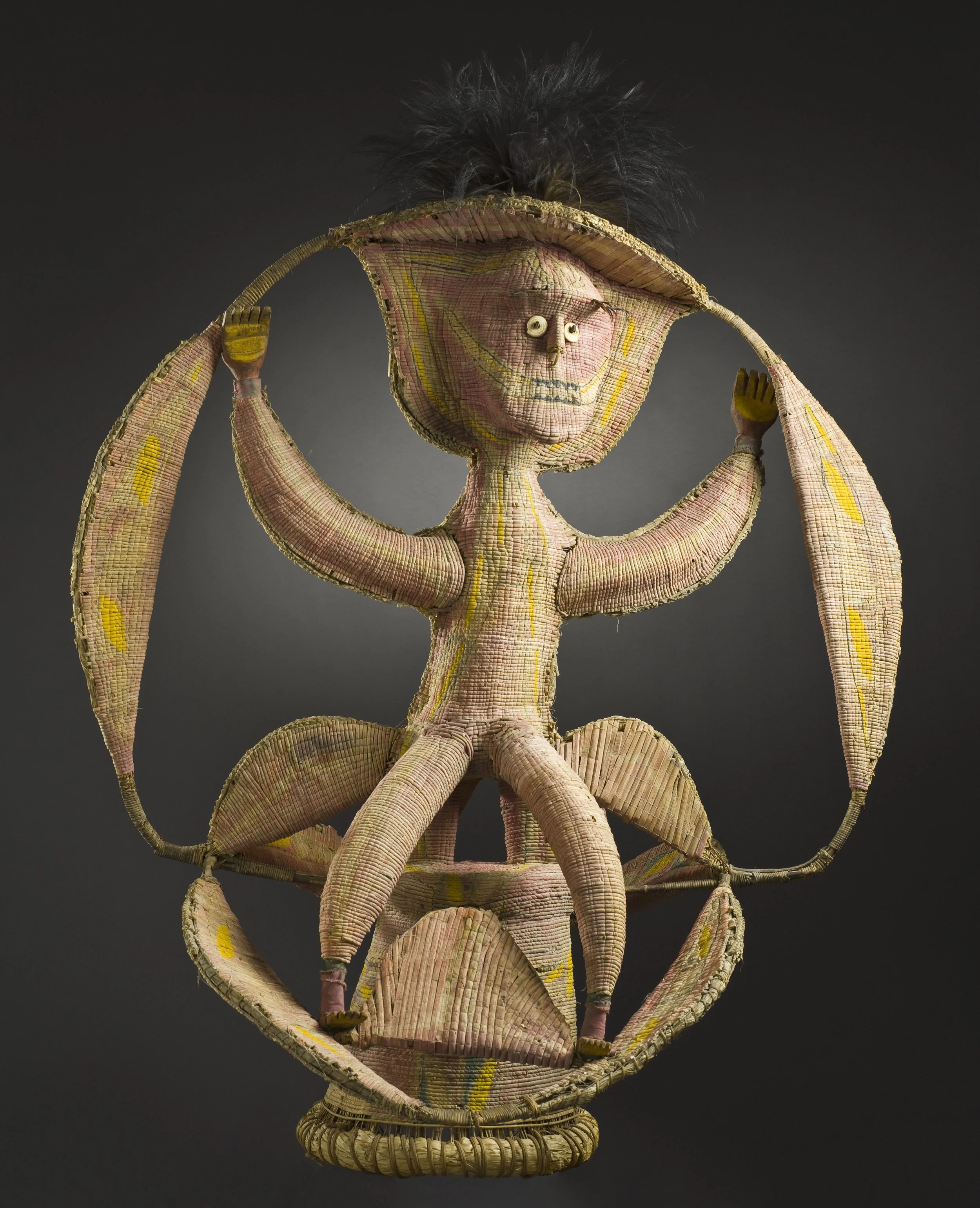
Dance Headdress
© LACMA
Sulka People
Papua New Guinea, New Britain
circa 1880
Wood, fiber, bark strips, shell, cassowary feathers, and pigment
Purchased with funds provided by the Eli and Edythe Broad Foundation with additional funding by Jane and Terry Semel, the David Bohnett Foundation, Camilla Chandler Frost, Gayle and Edward P. Roski, and The Ahmanson Foundation
Provenance: Völkerkundliches Mission Museum, Wuppertal. Wayne Heathcote (b. 1943), New York, NY, sold to; Masco Corporation Collection, Livonia, MI, sold 2008 through; [Sotheby’s, New York, to]; LACMA.
M.2008.66.5
14
Stone Figure
New Britain
Stone
Gift of the Masco Corporation
M.2009.127.7
15
Food Platter with Carved Human Figure Handle | Rova
Republic of Vanuatu, Espíritu Santo
circa 1800
Wood and fiber
Purchased with funds provided by the Eli and Edythe Broad Foundation with additional funding by Jane and Terry Semel, the David Bohnett Foundation, Camilla Chandler Frost, Gayle and Edward P. Roski, and The Ahmanson Foundation
Provenance: Anonymous (sale, London, Christie’s, 22 June 1981, lot 40). Wayne Heathcote (b. 1943), New York, NY, sold to; Masco Corporation Collection, Livonia, MI, sold 2008 through; [Sotheby’s, New York, to]; LACMA.
M.2008.66.23
16
Ancestor Figure | Tiki
New Caledonia, Northern Area
Wood
Gift of the Masco Corporation
Provenance: Linden Museum, Stuttgart (N.S. 10590). [Mathias Komor (1909–1984), Fine Arts & Antiquities, New York]. Anonymous (sale, London, Sotheby’s, 6 June 1983, lot 109). Wayne Heathcote (b. 1943), New York, NY, sold to; Masco Corporation Collection, Livonia, MI, gift 2009 to; LACMA.
M.2009.127.6
17
Ceremonial Shield | Grere'o
Solomon Islands, Santa Isabel Island
circa 1800
Basketry, parinarium nut paste, shell inlay, and pigment
Purchased with funds provided by the Eli and Edythe Broad Foundation with additional funding by Jane and Terry Semel, the David Bohnett Foundation, Camilla Chandler Frost, Gayle and Edward P. Roski, and The Ahmanson Foundation
Provenance: William Downing Webster (1868–1913), London, sold by 1901. Arthur Baessler (1857–1907), Berlin, gift 1902 to; Museum für Völkerkunde, Dresden (15 503). [Everett Rassiga (1922–2003), Gallery, Bern and Budapest]. Masco Corporation Collection, Livonia, MI, sold 2008 through; [Sotheby’s, New York, to]; LACMA.
M.2008.66.14
18
Mask | Tapuanu
Caroline Islands, Nomoi Islands (Mortlock Islands), Satoan Atoll (Satawan Atoll)
circa 1885
Wood and pigment
Purchased with funds provided by the Eli and Edythe Broad Foundation with additional funding by Jane and Terry Semel, the David Bohnett Foundation, Camilla Chandler Frost, Gayle and Edward P. Roski, and The Ahmanson Foundation
Provenance: Collected in 1887. Museum für Völkerkunde, Leipzig. Carlo Monzino (1931–1996), Lugano, Switzerland (sale, New York, Sotheby’s, 10 November 1987, lot 96, sold to); Masco Corporation Collection, Livonia, MI, sold 2008 through; [Sotheby’s, New York, to]; LACMA.
M.2008.66.13
All artworks and images presented in this feature are the property of LACMA.
© LACMA