
Primeval Waters: Lessons from Mesopotamia at the Musée du Louvre


Statue of Gudea known as "with a gushing vase"
AO 22126
© 2019 Musée du Louvre, Dist. GrandPalaisRmn / Raphaël Chipault


Primeval Waters

Lessons from Mesopotamia

May 20, 2026 — March 15, 2027


Crossed by the only two biblical ‘rivers of paradise’ known today, whose importance and danger may have inspired the Flood myth, ancient Mesopotamia was also the place where irrigation was first invented and developed. These early experiments in mastering water through artificial transformations of the natural environment led to the invention and development of the earliest known hydraulic structures (canals, bridges, aqueducts, pipe systems, artificial lakes and more) in Mesopotamia. These resulted in wide-ranging changes to the land and its inhabitants, whose long-term consequences, both positive and negative, will be explored in the exhibition. This exhibition draws from the extensive collection of the Department of Near Eastern Antiquities, which lends itself well to this subject, and winds through the department’s galleries to raise the issue of water within the Near Eastern antiquities collection and to explore what environmental lessons can be drawn there in both the past and the present.

Exhibition Curator
Ariane Thomas, Director of the Department of Near Eastern Antiquities, Musée du Louvre

Co-Curators
Barbara Couturaud and Grégoire Nicolet, Department of Near Eastern Antiquities, Musée du Louvre


Click the image below to watch a presentation of the exhibition Primeval Waters: Lessons from Mesopotamia.


Orthostate. Naval expedition of King Sargon II's army. Palace of Sargon II, Khorsabad.
AO 19889 ; N III 2893 ; LP 3511 ; N 8065 ; LONGPERIER 34 ; Pottier 1924, 43
© 2011 GrandPalaisRmn (Musée du Louvre) / Franck Raux

Seal of Ibni-sharrum, scribe of Shar-kali-sharri, king of Akkad
AO 22303
© 2025 Musée du Louvre, Dist. GrandPalaisRmn / Raphaël Chipault

Perforated relief: banquet and sacred navigation
AO 31015
© 1999 Musée du Louvre, Dist. GrandPalaisRmn / Jérome Galland

Ivory by Arslan Tash
AO 11455
© 2006 Musée du Louvre, Dist. GrandPalaisRmn / Raphaël Chipault

Bull statue
AO 11501
© 2019 Musée du Louvre, Dist. GrandPalaisRmn / Philippe Fuzeau

Figurine of Suhurmashu
AO 10884
© 2016 GrandPalaisRmn (Musée du Louvre) / Mathieu Rabeau

Baal stele with lightning
AO 15775; RS 4.427
© © 2006 GrandPalaisRmn (Musée du Louvre) / Franck Raux

Pazuzu demon figurine
MNB 467; Pottier 1917, 146
© 2007 Musée du Louvre, Dist. GrandPalaisRmn / Thierry Ollivier

Orthostate
AO 19854
© 1996 GrandPalaisRmn (Musée du Louvre) / Hervé Lewandowski

Fragmentary figurine: character mounted on a hybrid animal
AO 1500
© 2013 Musée du Louvre, Dist. GrandPalaisRmn / Thierry Ollivier

Statue of Gudea known as "with a gushing vase"
AO 22126
© 2019 Musée du Louvre, Dist. GrandPalaisRmn / Raphaël Chipault

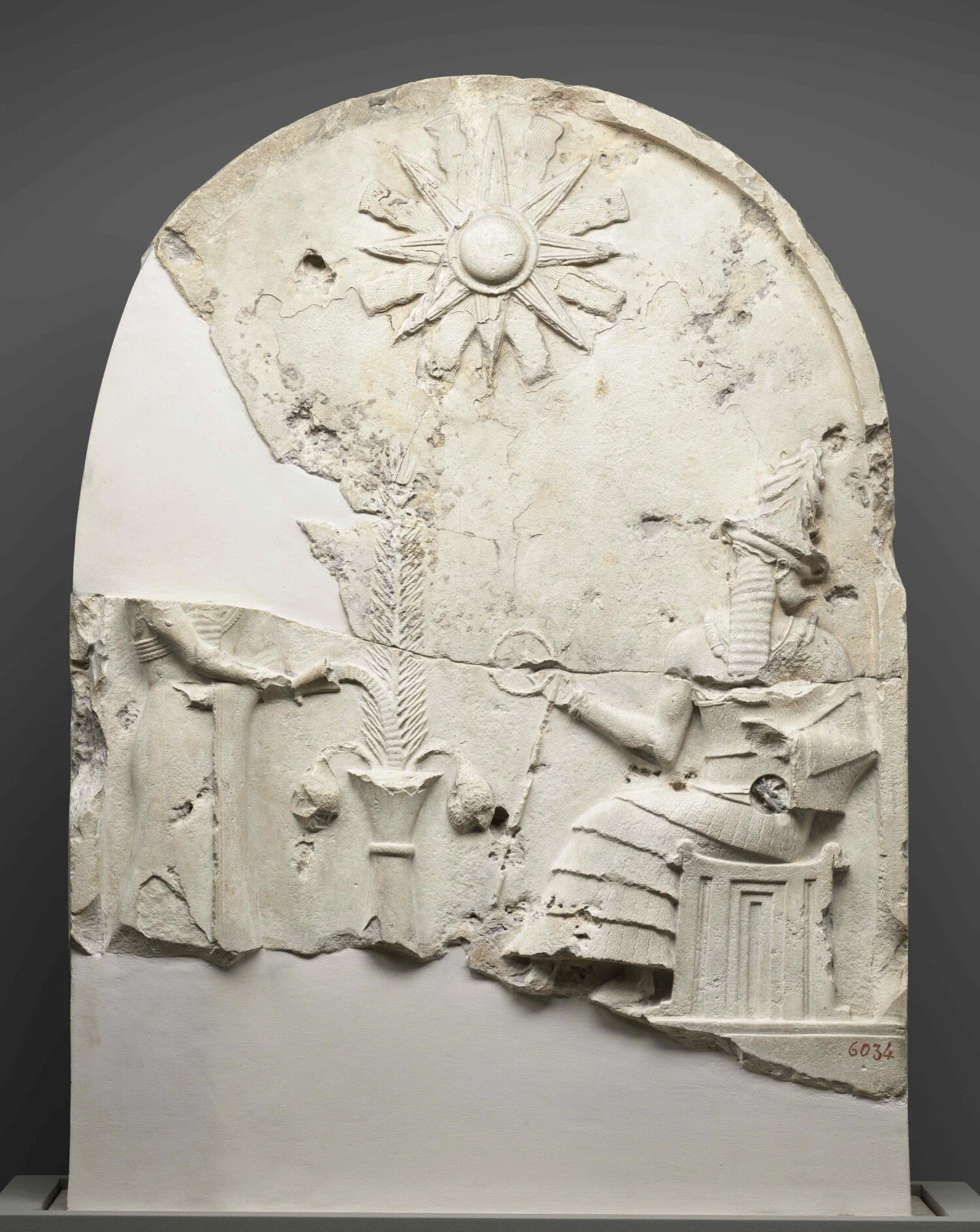
Stele: scene of libation before a divinity
SB7; AS 6034; PEZARD AND POTTIER 7
© 2015 GrandPalaisRmn (Musée du Louvre) / Mathieu Rabeau

Plate of Hell
AO 22205
© 1993 GrandPalaisRmn (Musée du Louvre) / Hervé Lewandowski

Orthostate
AO 19845
© GrandPalaisRmn (Musée du Louvre) / Jean-Gilles Berizzi

Orthostate
AO 19849
© 2003 GrandPalaisRmn (musée du Louvre) / Jean-Gilles Berizzi

Statue of Ain Ghaza
DAO 96
© 2004 Musée du Louvre, Dist. GrandPalaisRmn / Raphaël Chipault

Ivory from Arslan Tash: Sphinx
AO 11475
© 2006 Musée du Louvre, Dist. GrandPalaisRmn / Raphaël Chipault

Orthostate
AO 22198 ; RIMA 2 A.0.101.23.189
© 2003 GrandPalaisRmn (Musée du Louvre) / Jean-Gilles Berizzi

Colossal lion head
AO 8188
© 2018 GrandPalaisRmn (Musée du Louvre) / Mathieu Rabeau

Ivory from Arslan Tash: deer
AO 11458
© 2007 Musée du Louvre, Dist. GrandPalaisRmn / Raphaël Chipault

Bull’s head
AO 17207
© 2024 GrandPalaisRmn (Musée du Louvre) / Adrien Didierjean

Brick panel: passing lion
AO 21118
© 2007 Musée du Louvre, Dist. GrandPalaisRmn / Stéphane Olivier

Head of Mushushshu, animal of the god Marduk
AO 4106
© 2007 GrandPalaisRmn (Musée du Louvre) / Franck Raux