
Pacific Arts in the Museum of New Zealand Te Papa Tongarewa
Pacific Arts in the Museum of New Zealand Te Papa Tongarewa
Curated by Steven G. Alpert
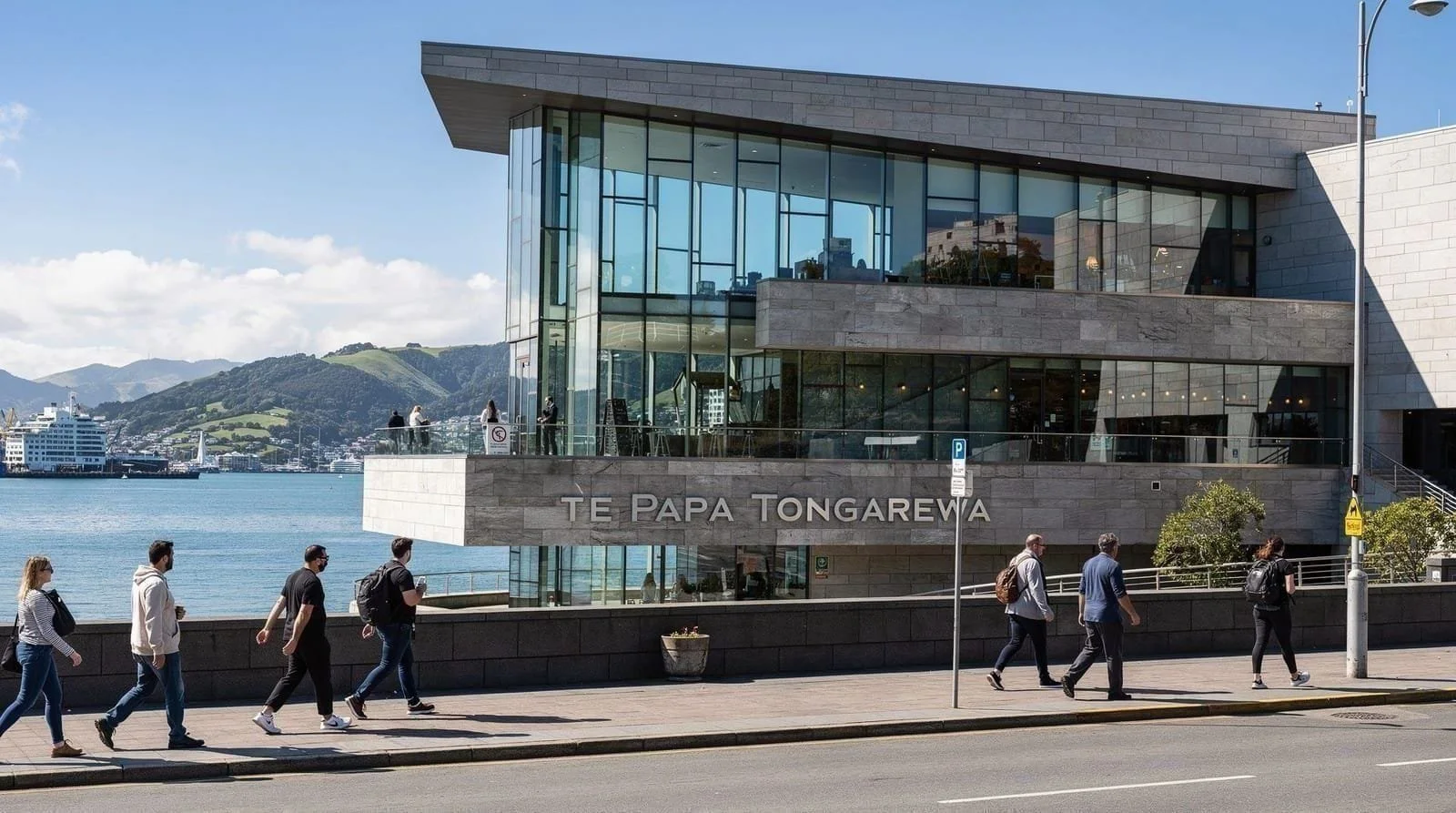
Te Papa is New Zealand's oldest museum. Located in the nation's capital, Wellington, the forerunner of what would eventually become the National Museum, or Museum of New Zealand Te Papa Tongarewa, was first established in 1865. It was then known as the Colonial Museum, originally conceived as a repository for storing the islands' 'scientific knowledge' for posterity. It also included documenting 'ethnographic curiosities' as well as paintings, prints, and items of interest relating to New Zealand and regional Polynesian or Pacific geography.
When I was a university student in New Zealand more than fifty-five years ago, the old Dominion Museum (as it was then called before it became the National Museum in 1972) on Buckle Street presented a remarkable unvarnished treasure trove of Māori and Pacific material. The collections housed in Te Papa, the Auckland War Memorial Museum, and the Otago and Canterbury Museums were further enhanced in 1948 when the New Zealand government bought the Māori and Pacific Islands Collection of William O. Oldman (1879-1949). His holdings probably ranked as the greatest collection of its type made in the first half of the 20th century. At the time, the government paid 44,000 British Pounds for its entirety, for material that would be worth many hundreds of millions of dollars today. Far beyond being a prescient financial outlay, the Māori, Melanesian and Pacific Islands cultural items or taonga ('a treasure' in Māori), acquired from Oldman are not only a testimonial to the skills of their makers and their descendants but also to the persistent efforts of one man and a government that had the foresight to acquire his collection.
In 1998, the current Te Papa opened, replacing the Dominion Museum. As it transitioned from the past to the present, and while dealing with complicated legacies, many changes have occurred in the perspective and presentation of the exhibits there. In addition to New Zealanders and interested outsiders of European descent, Māori iwi (tribes), hapu (sub-tribes), and individual families are now deeply involved with the museum, including loaning, donating, and gifting items to Te Papa. The museum seeks to steward and act as guardian (kaitiaki) of these cultural items. In 1992, it set new goals to enhance its appeal in an attempt to reach a broader contemporary audience. On Te Papa's website's 'history' page, there is a statement of purpose that affirms that the museum will:
be (in) a partnership between Tangata Whenua (Māori, the indigenous inhabitants of the land) and the heterogeneous citizens of New Zealand
speak with authority
represent and appeal to New Zealand's increasingly diverse society
be a place for discussion, debate, involvement and celebration
(where one) links the past, present and future.
Te Papa now holds some 2.5 million items, of which approximately 13,000 entries constitute both historical and contemporary non-Māori creations from the Pacific Islands. Some of these items are of great historical and aesthetic importance. For example, a number of early pieces in the collection are associated with the 18th-century voyages of Captain Cook and other early explorers. The collection also includes pieces that were once part of Queen Victoria's personal holdings. The roll call of collectors and donors is impressive. Major pieces came via colonial settlers, operatives, administrators, British aristocrats, and other diverse sources.
In 1912, Lord St. Oswald of the Winn family bequeathed thirty-five pieces to what is now Te Papa. This includes one of nineteen known basketry-framed images that most likely represent the Hawaiian god of war, Kūkaʻilimoku. "Kū, the snatcher of land" is depicted here in brilliant and rare feathers attached to a wicker frame, with piercing shell eyes and a gaping mouth of dog teeth to enhance its ferocity. While not directly attached to Cook, this is an 18th-century creation. Two other illustrated items also from the St. Oswald collection are certainly from one of Cook's three voyages to Tahiti (1769-1777). They include an ethereal, ghostly headdress (parae) fashioned from mother of pearl, coconut coir, turtle shell, and the white tail feathers of the tava'e (Phaeton lepturus). There is also a labor-intensive gorget (taumi) composed of shark teeth, feathers, sennet, human and dog hair. High chiefs wore these adornments in battle or used them as high-value exchange gifts.
Illustrated are also seven diverse objects formerly in the Oldman collection. A humble Hawaiian shark tooth knife (Niho oki) is comprised of a sublimely polished wooden grip paired with a serrated shark's tooth. When tightly cinched together with sennet fiber, it produces an elegant and formidable weapon. A beautiful Marquesan bone Tiki ivi po'o was most likely once attached as a beautifying or protective talisman to a container or personal belonging, or as an ornament for a body or hair braid. Such toggles were often fashioned from oblong sections of human arm and leg bones taken from vanquished enemies. There is also a reasonably early tanoa or serving bowl in the shape of a spread leaf or an opening seed pod. At the bowl's neck is a formidable Marquesan face with large rounded eyes. A final manifestation of Marquesan art is a full-bodied figure, or tiki, used to ornament and bless a canoe from the 19th century. Scrolling through Te Papa's Marquesas section online, there is an even finer ex-Oldman canoe figure for our readers to discover there. (#OL000190).
In fact, Te Papa’s collection includes many non-Māori Pacific items to admire. A superb Easter Island figure, or moai kavakava, generally considered to be the image of an ancestor, was certainly carved by the beginning of the 19th century or earlier. Museum notes state that it is one of the first documented figures of its type to reach England in either 1828 or 1835. Another is a masterwork in miniature from Eastern Polynesia from somewhere between the easternmost Cook Islands and Tahiti. Here, a bent-knee figure is mounted on an elongated shaft whose end is perforated with small holes. The size and construction of this piece suggest that it might have once been a handle or the stem of a chiefly or sacred flywhisk. This carving has a long history. It was originally brought to England in 1825 by a London Missionary Society worker named George Bennett, who had been previously stationed in the Society Islands.
Additionally, a piece that Oldman greatly admired is the top of a Rarotonga god staff (atua rakau). Early European visitors saw many variants of this type of finial at the end of poles in sizes ranging from around 28 inches to 18 feet tall. Larger figurative carvings, such as this one, are mostly fragmentary. A pole's base was normally phallic while the unembellished midsections were bundled and swathed in rolls of tapa cloth. Larger god staffs that were not consigned to Christianity's fires were generally and purposefully broken or cut away from their decorated tops. This beautiful example of the genre dates to ca. 1800 or earlier, as all of the island's traditional religious carvings disappeared somewhere between 1823 and 1827 with the arrival of the LMS or London Missionary Society.
Other outstanding Polynesian items highlighted this month include a rare short club, an akau tau (literally 'a striking instrument fashioned from wood'). This piece is early, probably 18th century. Although the old Dominion Museum purchased it in 1964, it is of such good quality that it probably comes from an early European voyage, perhaps even Cook's. Many items often attributed to Fijian manufacture were actually largely crafted by Tongan artisans and boat builders who both traded and raided in the southern islands of Fiji and settled on the island of Vitu Leva in the second half of the 18th century. (See: Cartmail, The Art of Tonga, pp. 101-105) A good example of mistaken identity can be seen in a very fine breast ornament fashioned from whalebone. This piece most likely dates to the mid-19th century, or perhaps a little earlier, and is an example of cross-cultural interaction. The Fijian Vitian warriors used bows in warfare. Most likely, the earliest large, plain breastplates employed by Tongan warriors were worn in close combat for protection against arrows. These designs evolved in the 1800s into the inlaid or composite breast ornaments worn by chiefly Fijians. The finest of these ornaments point to Tongan artistry and manufacture.
We also feature two stellar examples of decorated Polynesian barkcloth. In fact, our word 'tapa' is directly from the language of Tahiti or the Cook Islands. (See: Alpert: “Bark Cloth of Island Southeast Asia in Global Museum Collections”) In Hawaiian, it's known as kapa. Te Papa has a number of early Hawaiian painted kapa. The one posted below was donated, along with 500 Māori taonga and diverse Pacific artifacts, by the estate of the famous bibliophile, Alexander Turnbull, in 1918. This beautiful cloth, with its early vein-like or plant-like abstractions, could date as early as Cook's third voyage (1778-1779), or perhaps to soon after, when Hawaii was revisited by Captains Portlock and Dixon, or during the French expedition of Comte de Lapérouse. A fine poncho from one of the world's largest coral islands, Niue, is also featured; it is composed of eight squares, each centered with four triangles filled with finely composed cross hatches and line drawing. Creating barkcloth ponchos was actually foreign to Niueans. They most likely developed this tradition after coming into contact with Tahitian models introduced by Samoan missionaries in the 1830s. In the spirit of their European handlers, early inter-island missionaries often encouraged people to be more modest and to wear such items of clothing.
Material originating from the West of Polynesia, what we used to call Melanesia, is now often referred to as coming from the Western Pacific. Six items from diverse Western Pacific island cultures are featured this month.
The artistic offerings of this geographical area include some of the most visually energetic examples of old tapa extant. Of particular interest are the famous figurative tapa cloths of Lake Sentani and Humboldt Bay, an area which is now part of Indonesia, and those from cultures found on the island of New Britain. While New Britain lies to the northeast of New Guinea, today it is part of the expanded nation of Papua New Guinea. From this region, Te Papa stewards a fine section of a painted tapa cloth created by the Baining people of the Gazelle Peninsula in East New Britain. The designs on their tapa are said to embody aspects of an ancestor, animal, or a specific forest spirit. Generally, this type of tapa was created to cover ceremonial masks or constructions (made of cut bamboo, reeded cane and split rattan) that were displayed or danced before being traditionally discarded or destroyed.
With the exception of Hawaiian gourd masks (makini), worn masks were largely unknown in old-time Polynesia. However, masks are famous from the Mortlock Islands (Nomoi atolls) in Micronesia and are ubiquitous among many distinct groups in Melanesia. Showcased here is a sublime mask from New Ireland, ca. 1900, of a type displayed and used during funerary and mortuary ceremonies (the Malangan cycle) to honor the dead and assist in their journey to the spirit world. This emotive mask, again from the Turnbull Bequest, uses the same materials as a Baining mask, but includes several unusual additions. Its blond, curly, tufted coiffure is natural sponge, while its wooden face is over-modeled with pigmented beeswax.
Sometimes descriptions, borders, etc. are a bit like how we appear to be on the outside, as opposed to our complex inner DNA. For instance, if one thinks of greenstone artifacts fashioned from nephrite, one immediately thinks of the magnificent creations of the Māori people. Nephrite, or soft jade, is an intractable stone (though often confused with jadeite, which is harder) that had to be laboriously worked and shaped over a multi-month process. The work was done with grinding stones, fine points, and stick drills, using an abrasive slurry, muscular friction, and water. Fine adzes were valued all over the Pacific, but greenstone or nephrite, owing to its hardness and polish, was particularly prized. New Caledonia, which lies in the southwest Pacific Ocean, is geographically and culturally Melanesian. Yet it was also home to Austronesian-speaking Lapita peoples, as well as Polynesian or Polynesia-influenced peoples. A New Caledonian nephrite adze in Te Papa's collection is a fine example of one of their stone implements. Currently, the oldest datable stone round heads for chiefly batons and pure axe-head shapes in a similar stone that have been archaeologically found date back to the 15th century. (See: Alpert: “The Art and Artifacts of New Caledonia”)
No introduction to Te Papa's collection would be complete without going to the edge of the Western Pacific to New Guinea (PNG), and to the Torres Strait, which lies off the southern coast of New Guinea where the Coral Sea (its Pacific component) meets the Arafura Sea of the Indian Ocean. From Papua New Guinea (now known as the 'Independent State of Papua New Guinea'), there is a turn-of-the-century archer's arm shield from the Huon Gulf. This classic example of the genre features two vibrant and aggressive faces, raised elements and natural ochres that make it visually stand out. Also from PNG is a lime spatula topped by a squatting figure whose maker, Mutuaga (c. 1860-c.1920), is well-known. Knowing the style and hand of a particular artist from a traditional culture who lived and worked in the 19th century is rare. Mutuaga came from Dagodagoisu village in the South Cape Massim region of Milne Bay. His production of spatulas and figures was remarkably prolific. Their facial features are distinctive and easily recognizable. (See: Beran: Mutuaga: A Nineteenth Century New Guinea Master Carver, plate 53, 1996 and Alpert: “Arts of the Milne Bay and the Trobriand Islands in Global Collections | Part I”)
Te Papa further illustrates two superb Torres Strait masks in their online collections database. One is a very fine ex-Oldman mask known as a Mawa from Saibai Island (#OL000731). These rare masks, depicting elongated faces and carved from wood, are said to represent mythical heroes who appear at funerals, the annual harvesting of crops or fruit, or important rite-of-passage ceremonies to signal the commencement of an important event and further spiritualize its importance. The second type of mask, mainly fashioned from tortoiseshell, was first seen by a European in 1606 by Luis Vaz de Torres, after whom the Strait is named. These masks were crafted from carefully cut and fitted pieces of polished tortoiseshell (locally known as buk or krar, or, for hero/ancestor masks, le op), then sewn and lashed together to create theatrical effigies and masks. (See Alpert: “Art of the Torres Strait Islands in the British Museum”)
While not one of the islands' most wildly complex or composite zoomorphic masks, Te Papa's tortoiseshell mask is nevertheless visually arresting and quite unusual, perhaps even unique. It has two pairs of eyes. The lower ones are semi-shuttered while the upper eye sockets are large and stare straight at onlookers. One of each pair is still inlaid with shell. Hanging from the mask's cut-out tortoiseshell beard are hair-like cassowary feathers, dangling candle nuts and shells. Atop his head is a European-styled hat that speaks to the changing times when this mask was made and to the artistic adaptability and skills of its maker. This particular le op style mask was gifted to the museum in 1875 by George Phipps, while he was the Governor-General of New Zealand. It is unknown whether this remarkable mask or headpiece was created for Phipps, who had previously served as the Governor of Queensland (1871-1874). During this time, Letters of Patent were issued that included the Torres Strait Islands, which ultimately led to their absorption in 1879 into what was then Britain's colony of Australia.
To carry the thought a bit further, I have always marveled at what people place on their heads. It often reveals something about who someone was within a culture: their martial or social status, belief systems, and perhaps even a bit of their political history at any given moment in time. The last image is also of a type of headgear. Many museums and private collectors possess examples of shark-toothed weapons or full suits of armor woven from coconut fiber string, or coir, from the Micronesian Republic of Kiribati (formerly the Gilbert Islands). What is often missing from these assemblages are their distinctive battle helmets, fashioned from the inflated and dried body of a puffer or porcupine fish. What might their defensive suits and helmets infer? Kiribati is formed from low-lying coral atolls (save one island), which perhaps reflects a sort of 'sea vision' of the world around them? These ensembles were made by skilled craftsmen capable of engineering protective gear (without metal technology): ancient flak jackets with leggings, arm and neck guards once used in duels and in what early observers described as conditions that lent themselves to 'incessant' warfare.
In closing, the Oceanic collections in major and regional museums in New Zealand and Australia contain important and visually stunning items from both local and Pan-Pacific cultures. In this regard, Te Papa is not an exception, but a reflection of New Zealand's, of 'Aotearoa's' —the Land of the Long White Cloud— cultural diversity and fabled natural beauty.
— Steven G. Alpert, founder of Art of the Ancestors
1
Feathered Image | `aumakua hulu manu Kūka`ilimoku
Hawaii
1700s
Feathers, animal teeth, pearlshell and plant fibres
Gift of Lord St Oswald, 1912
FE000325
2
Tooth Knife | Niho Oki
Hawaii
1700s
Wood, plant fibre, tooth
William Ockleford Oldman Collection
Gift of the New Zealand Government, 1992
OL000559
3
Bark Cloth | Kapa / Tapa
Hawaii
1770s
Bark cloth, pigments
Gift of the Trustees of the Turnbull Estate, 1918
Previously owned by Alexander Turnbull
FE001475/1
4
Ornament | Tiki ivi po'o
Marquesas Islands
1800s
Bone
William Ockleford Oldman Collection
Gift of the New Zealand Government, 1992
OL000226/2
5
Canoe Prow
Marquesas Islands
1800s
Wood
William Ockleford Oldman Collection
Gift of the New Zealand Government, 1992
OL000189
6
Bowl | Tanoa
Marquesas Islands
1800s
Wood, plant fibre
William Ockleford Oldman Collection
Gift of the New Zealand Government, 1992
OL000192
7
Poncho | Tiputa
Niue
1800s
Tapa, dyes
Augustus Hamilton Collection Purchased 1914
FE000289
8
Short Club | `akau-tā
Tahiti
1700s
Wood
Purchased 1964
Previously stewarded by Royal United Services Institute
FE004261
9
Staff God | Atua rakau
Rarotonga
circa 1800
Wood
William Ockleford Oldman Collection
Gift of the New Zealand Government, 1992
OL000423
10
Headdress | Pārae
Tahiti
1700s
Coconut fibre (sennit); pearl shell (Pinctada magaritifera); turtle shell; Frigate bird (Fregata magnificens); Giant mussel (Atrina Vexillum), White-tailed tropicbird Phaethon lepturus
Gift of Lord St Oswald, 1912
FE000336/2
11
Gorget | Taumi
Tahiti
1700s
Feathers, sennit, shark teeth, wood, human hair and dog hair
Gift of Lord St Oswald, 1912
FE000335
12
Female Deity
Cook Islands
circa 1800
Wood
William Ockleford Oldman Collection.
Gift of the New Zealand Government, 1992
OL000370
13
Human Figure | Moai kavakava
Easter Island
1800s
Wood, bone, shell, obsidian
William Ockleford Oldman Collection
Gift of the New Zealand Government, 1992
OL000342
14
Breast Ornament | Civa
Fiji
1800s
Whale bone, sennit, coconut, husk (plant material)
Gift of G Downie, 1881
FE002126
15
Malagan Mask | Nicmaget
New Ireland, Papua New Guinea
circa 1900
Wood, cane, bark cloth, pigment, plant fibre, gum
Gift of Alexander Turnbull, 1916
FE001100
16
Adze Blade
New Caledonia
Nephrite
Gift of WL Travers, date unknown
FE002247
17
Bark Cloth | Tapa
New Britain, Papua New Guinea
Bark cloth, pigments
The late Rev. John A Crump Collection.
Gift of Mrs JA Crump, 1935
FE004100
18
Archer Shield
Papua New Guinea
circa 1900
Wood, pigment
Gift of Mr J.D. Hutchin, 1948
FE006516
19
Figurative Lime Spatula by Mutuaga
Milne Bay, Papua New Guinea
1900-1920
Wood, lime
Purchased 1977
Previously owned by Arthur Eady
FE006960
20
Mask
Torres Strait
circa 1870
Turtle shell, sennit, candle nuts, shells, feathers, pigment
Gift of Viscount George Phipps, Marquess of Normanby, 1875
FE000530
21
Porcupine Fish Helmet | Te tauti
Kiribati
1900s
Human hair, fish skin, plant fibre, sennit, pandanus
Gift of Jennifer Orange, 1995
Previously owned by Sir Albert Ellis
FE010482
All artworks and images presented in this feature are the property of the Museum of New Zealand Te Papa Tongarewa.
© Museum of New Zealand Te Papa Tongarewa